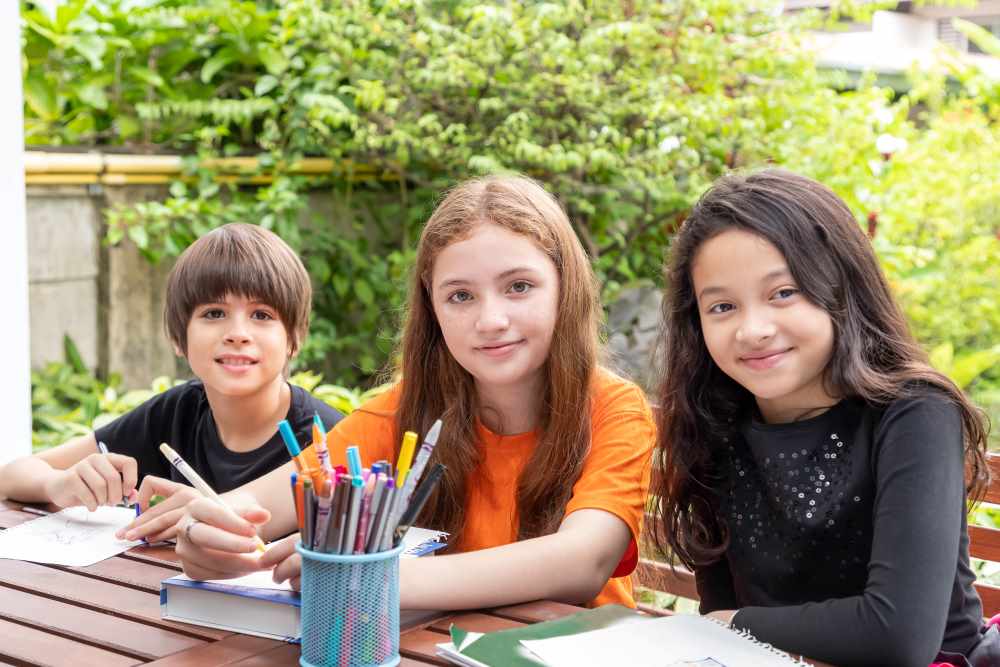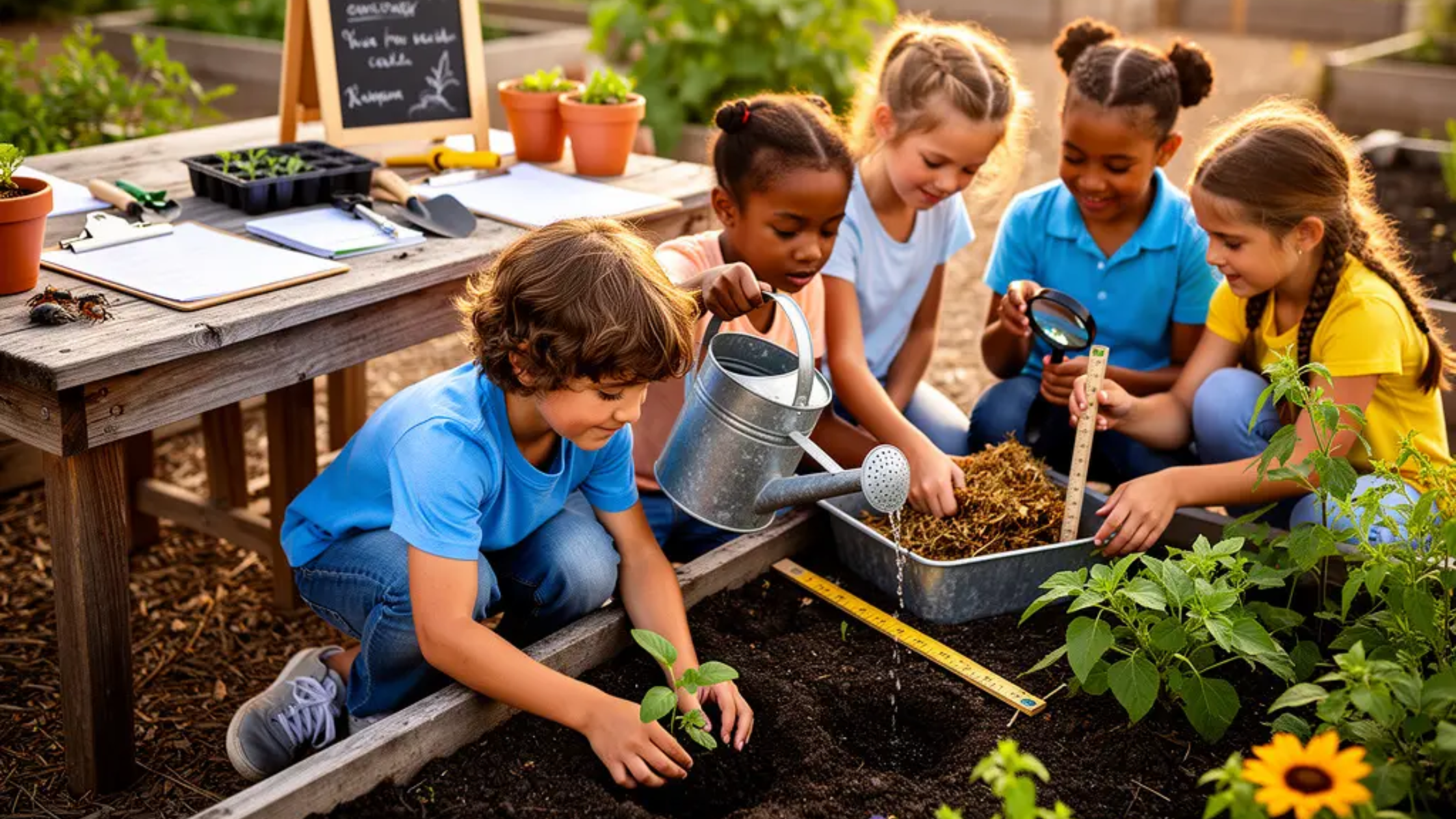
Picture this: a group of third graders kneels in the school garden, carefully harvesting rainbow chard and cherry tomatoes they planted weeks ago. Later today, they will measure, chop, and sauté their harvest while calculating fractions and discussing plant biology. Meanwhile, across campus, fifth graders are deep in the ponderosa pine forest surrounding our Prescott campus, collecting bark samples and sketching observations in their nature journals, connecting what they see to lessons on ecosystems and adaptation.
This is not a special field trip. This is just Tuesday at Mountain Oak Community School.
If you have watched your child zone out over worksheets or heard them say “school is boring,” you already know that traditional desk-based learning does not work for every child. Many parents in Prescott are searching for something different—an education that honors how children naturally learn: by doing, touching, building, exploring, and asking questions.
At Mountain Oak, hands-on experiential learning is not an add-on. It is the foundation of everything we do for our PreK through 8th-grade students.
What Hands-On Experiential Learning Looks Like at Mountain Oak
Experiential learning means students actively construct knowledge through real-world experiences rather than passively receiving information. Research demonstrates that experiential learning increases engagement, critical thinking, and long-term retention compared to traditional lecture-based methods.
At Mountain Oak, we bring this approach to life daily in our intimate class sizes of just 8 to 12 students.
Examples from Our Classrooms
Garden-to-table projects: Students in every grade level participate in planting, tending, harvesting, and cooking food from our on-site garden. PreK students learn about seed germination by getting their hands dirty. Fourth graders calculate growing seasons and track plant growth data. Middle schoolers research sustainable agriculture and design garden expansions.
Outdoor science in Prescott’s forests: Our campus sits surrounded by ponderosa pine forest, which becomes an extended classroom. Students conduct water quality tests in nearby creeks, identify native species, study geological formations, and monitor seasonal changes. Studies show outdoor learning environments significantly improve academic achievement and student well-being, particularly in science comprehension.
Building and maker projects: Whether constructing bridges to test engineering principles, designing Rube Goldberg machines to explore physics, or building birdhouses for local wildlife, students use real tools and materials to solve authentic problems. They learn measurement, geometry, and spatial reasoning while developing practical skills.
Art integrated across disciplines: A history unit on ancient civilizations includes creating authentic pottery using traditional techniques. A literature study becomes a script students perform. A math lesson on symmetry leads to collaborative mural painting. Art is not separate from academics; it deepens understanding of every subject.
Community partnerships and field studies: Students interview local business owners, volunteer at the Prescott animal shelter, visit working farms, and collaborate with community organizations. These experiences teach civic responsibility while connecting classroom learning to the real world.
Hands-on math manipulatives: Forget endless worksheets. Students use base-ten blocks, fraction bars, geometric solids, and pattern blocks to visualize abstract concepts. They play strategy games, measure ingredients for recipes, and design scale models. Math becomes something you do, not just something you memorize.
Writer’s workshop and authentic audiences: Students write letters to real people, create books for younger readers, and publish work for genuine audiences. They interview family members for oral history projects and collaborate on class magazines. Writing has purpose beyond a grade.
Why Experiential Learning Matters
Traditional education often prioritizes memorization and test performance over deeper understanding. Students sit in rows, fill out worksheets, and prepare for standardized assessments. But ask those same students what they learned last month, and many cannot tell you.
Experiential learning flips that model. When children physically engage with materials, collaborate on projects, and apply knowledge to solve real problems, they develop genuine understanding that lasts. Research consistently shows that hands-on learning builds critical thinking skills, problem-solving abilities, and creativity in ways passive instruction cannot match.
Schedule a tour to see hands-on experiential learning in action at Mountain Oak.
“When I visited Mountain Oak, I watched my daughter solve a complex fraction problem using colored blocks and suddenly everything clicked for her. She had been struggling for months with worksheets at her previous school. Seeing her face light up with understanding made me realize how much learning potential we had been missing.”
At Mountain Oak, small class sizes of 8 to 12 students allow teachers to facilitate this kind of breakthrough moment regularly. Every child receives individualized attention. Teachers notice when concepts are not clicking and can immediately adjust their approach, pulling out different materials or trying a new method.
Real Outcomes for Students
What happens when children learn through experience rather than memorization? The results are remarkable.
Deeper curiosity: Students who actively explore subjects develop authentic interest. They ask more questions, pursue independent research, and connect ideas across disciplines.
Stronger critical thinking: Experiential learning develops higher-order thinking skills because students must analyze, evaluate, and synthesize information to complete projects.
Enhanced creativity: Open-ended projects with multiple solution paths encourage creative thinking.
Greater resilience: Hands-on challenges teach persistence and that failure is part of learning.
Improved collaboration: Project-based work requires communication, compromise, and teamwork.
Lifelong love of learning: Experiential education nurtures intrinsic motivation.
How Mountain Oak Addresses Parent Concerns
Parents tell us they worry about several things at traditional schools. Let us address those concerns directly.
Concern: Endless worksheets that feel meaningless
At Mountain Oak, worksheets are rare. When students do practice skills, it is embedded in purposeful contexts.
Concern: Too much screen time
We prioritize hands-on physical experiences over digital ones. Technology is used strategically, not excessively.
Concern: Lack of engagement and boredom
Our curriculum centers on real questions, authentic problems, and topics students genuinely find interesting.
Concern: Disconnection from nature
At Mountain Oak in Prescott, Arizona, our campus is surrounded by ponderosa pine forest that we use as an outdoor classroom year-round.
Comparing Passive Versus Active Learning
| Aspect | Passive Learning | Active, Experiential Learning |
| Student Engagement | Students listen to lectures, read textbooks, complete worksheets independently | Students actively participate in projects, experiments, discussions, and hands-on activities |
| Typical Activities | Memorizing facts, filling out worksheets, taking tests, sitting at desks | Building models, conducting investigations, solving real problems, creating presentations, outdoor exploration |
| Learning Outcomes | Short-term memorization, surface-level understanding, difficulty applying knowledge | Deep comprehension, critical thinking, ability to transfer skills to new situations |
| Screen Time | Often includes digital worksheets and computer-based practice drills | Limited, purposeful technology use; emphasis on physical, hands-on experiences |
| Assessment | Standardized tests, quizzes, multiple-choice exams | Portfolios, presentations, demonstrations, completed projects, reflective discussions |
Frequently Asked Questions
Does hands-on learning prepare students for standardized tests and future academics?
Absolutely. Students who deeply understand concepts through experiential learning perform well on assessments because they genuinely comprehend the material rather than temporarily memorizing it.
How do you ensure academic rigor with project-based learning?
Experiential learning is extremely rigorous because it requires students to apply knowledge in complex ways.
What if my child is behind or ahead of grade level?
Our small class sizes and hands-on approach allow for exceptional differentiation. Teachers meet students where they are and facilitate growth from that point.
Enrollment and Next Steps at Mountain Oak Community School
If you are ready to see hands-on experiential learning in action, we invite you to visit our Prescott, Arizona campus. Watch students engaged in authentic work. Observe our intimate class sizes of 8 to 12 students. Experience the difference.
Space is limited precisely because we maintain small class sizes. Many grades fill early as families discover what experiential education can offer their children. We serve PreK through 8th-grade students who thrive when learning becomes active, meaningful, and joyful.
Take the next step:
- Schedule a tour to see our classrooms, meet our teachers, and watch experiential learning in action.
- Call 928-541-7700 to speak with our admissions team about availability.
- Visit our campus to experience the Mountain Oak difference firsthand.
Do not wait. With class sizes limited to just 8 to 12 students, spots fill quickly. Give your child the gift of education that ignites curiosity, builds confidence, and prepares them not just for tests, but for life.
Ready to Transform Your Child’s Education?
Mountain Oak Community School is enrolling now for PreK through 8th grade.
✓ Schedule a tour and see hands-on learning in action
✓ Call 928-541-7700 to discuss enrollment for your child
✓ Limited spots available in our small classes of 8–12 students
Your child deserves an education that celebrates how they naturally learn. Let us show you what that looks like at Mountain Oak in Prescott, Arizona.