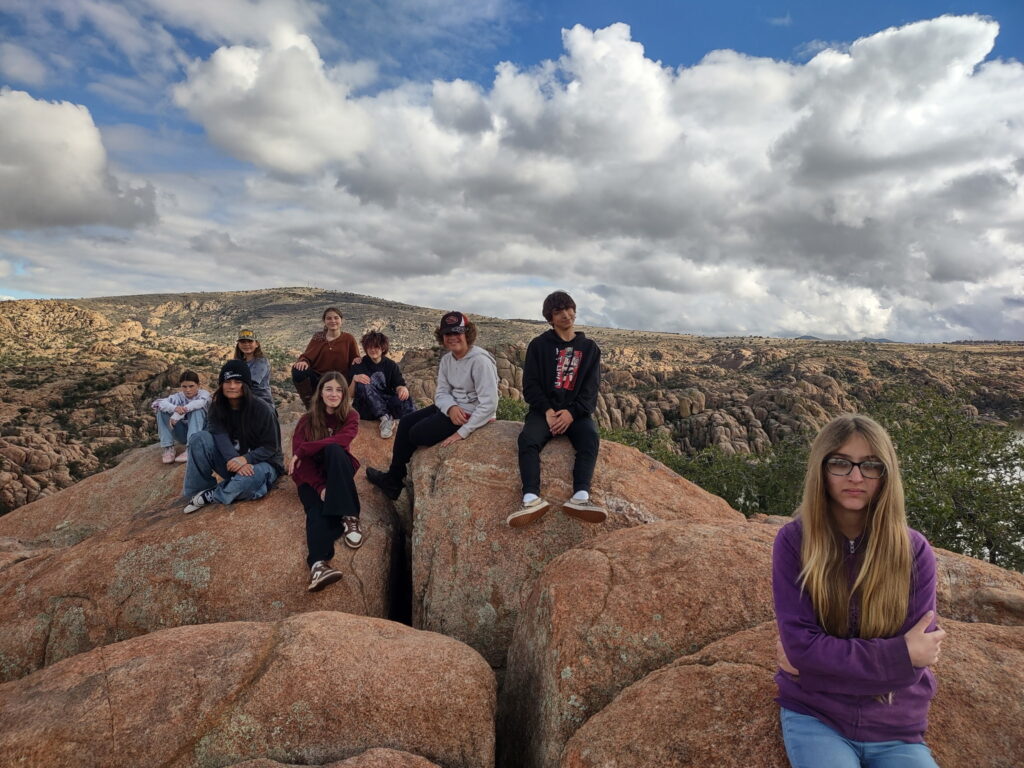
Our Combined Class Approach
Our 7th/8th grade combined curriculum represents a thoughtful integration of developmental stages, where students aged 12–14 engage with shared disciplines while experiencing differentiated learning pathways. This structure honors the unique developmental needs of each grade level while fostering a collaborative learning community.
Seventh graders build foundational understanding through concrete exploration and guided inquiry, developing essential research skills and critical thinking abilities. Eighth graders deepen their engagement with more complex analytical practices, independent research, and sophisticated connections to real-world applications.
Throughout the year, students develop robust research methodologies, learn to evaluate sources critically, construct evidence-based arguments, and make meaningful connections between academic content and contemporary issues. This approach cultivates intellectual curiosity, analytical rigor, and the capacity for independent thought—essential skills for lifelong learning.
Unit 1: Food, Nutrition, and Farming
Students explore the complex relationships between food systems, human health, and agricultural practices. This unit examines how industrialized food production has transformed our diets and health outcomes, while investigating alternative approaches that prioritize sustainability and wellness.
- Industrialized food systems and their impact on public health
- Regenerative agriculture, organic farming, and localized food networks
- The science of processed foods and their effects on the gut microbiome
- Understanding the obesity epidemic in the United States
- Human digestive physiology and nutritional science
- Historical evolution of human diets across cultures and time periods
- Field experience at Mortimer Farm
- Anatomical drawing with scientific dictation
- Essay writing focused on digestive processes and nutrition
Unit 2: US History and Politics
This unit provides students with a comprehensive understanding of American governmental structures, historical foundations, and contemporary political processes. Students examine how democratic principles are applied in practice and develop skills in civic engagement and critical analysis of political systems.
- Foundational documents: The Bill of Rights and the Constitution
- Economic systems and the military-industrial complex
- Structure of government and the legislative process
- Contemporary political issues: Save the Dells initiative, Highway 89 development
- Campaign finance, lobbying, and special interest influence
- Mock debates and public speaking skills
- Distinguishing between primary and secondary historical sources
- Analyzing geopolitical cause and effect relationships
- Understanding civic responsibility and informed citizenship
Unit 3: Geology & Mineralogy
Students investigate Earth’s dynamic systems through hands-on exploration of rocks, minerals, and geological processes. This unit combines field study with theoretical understanding, emphasizing local geological features and their formation over millions of years.
- Distinguishing rocks from minerals and their industrial applications
- Earth's internal structure: crust, mantle, outer core, and inner core
- Field geology: identifying minerals through cleavage and luster
- Plate tectonics theory and earthquake mechanics
- Continental drift evidence and seafloor spreading
- Local geological formations: Granite Dells, Thumb Butte, Grand Canyon
- Geological time scales and rock formation processes
- Field trip to local geological sites (TBD)
- Integrated artistic representation of geological concepts
Unit 4: Geography - China
This comprehensive study of China integrates historical development, contemporary politics, cultural traditions, and economic systems. Students develop research skills through independent inquiry while gaining understanding of one of the world’s most influential civilizations.
- Ancient philosophical traditions: Taoism and the I Ching (Book of Changes)
- The Tang Dynasty and classical Chinese civilization
- Buddhism's introduction and influence in China
- The Communist Revolution and establishment of the PRC
- Tiananmen Square protests and contemporary political structure
- Modern Chinese culture, society, and global economic influence
- Student-choice research project on Chinese topics
- Formal research paper with proper citations and analysis
- Geographic features and their influence on Chinese development
Unit 5: Biology
Students explore the fundamental unit of life—the cell—through microscopic investigation and theoretical study. This unit builds understanding of cellular processes that sustain all living organisms, from single-celled bacteria to complex multicellular life.
- Cell structure and the functions of organelles
- Cell membrane structure and selective permeability
- Transport mechanisms: diffusion, osmosis, active transport
- Cellular respiration and ATP production
- Photosynthesis and energy conversion in plants
- Comparing and contrasting plant and animal cells
- Cell division: mitosis and meiosis (time permitting)
- Microscopy techniques and field studies
- Possible field trip to biological research facility
Unit 6: Roman History
This unit examines the rise and influence of Roman civilization, tracing its development from mythological origins through republican government to imperial expansion. Students explore how Roman political structures and cultural achievements continue to shape Western civilization.
- The Trojan War and Rome's legendary founding
- The Seven Kings of Rome and early Roman society
- Geographic expansion and the Roman Empire's territorial reach
- Greek mythology's influence on Roman culture and religion
- The Roman Republic and its influence on modern democracies
- Roman law, engineering, and architectural innovations
- The transition from Republic to Empire
- Integrated art study: Greek and Hellenistic sculpture
- Impressionism and its classical influences
Language Arts (Ongoing Throughout the Year)
Language Arts instruction develops sophisticated literacy skills through engagement with challenging texts, analytical writing, and oral presentation. Students learn to read critically, write persuasively, and communicate effectively across multiple contexts.
Reading and Analysis
- Non-fiction texts and historical documents
- Analyzing explicit and implicit meaning in complex texts
- Making evidence-based inferences
- Recognizing author bias and perspective
- Analyzing conflicting texts and reconciling different viewpoints
- Differentiating between primary and secondary research sources
Writing Skills
- Argumentative writing with clear claims and supporting evidence
- Constructing logical arguments with counterarguments
- Revising for clarity, coherence, and impact
- Editing for grammar, mechanics, and style
- Proper formatting and citation practices
- Research paper development and execution
Literary Analysis
- Identifying and interpreting symbolism
- Understanding analogies and metaphorical language
- Drawing cultural and historical parallels
- Analyzing themes across multiple texts
- Guided study questions to deepen comprehension
Class Readers
- To Kill a Mockingbird by Harper Lee
- Fahrenheit 451 by Ray Bradbury
- 1984 by George Orwell
Oral Communication
- Reading aloud with appropriate pacing and expression
- Voice projection and articulation techniques
- Intonation and emphasis for meaning
- Public speaking and presentation skills